
projects/ energy-harvesting-using-thermal-electric-generators
Harvesting the Desert Night: A DIY Thermoelectric Energy Project
I am working on a prototype to see if its feasible to produce electricity from the residual heat produced during the day, using Thermal Electric Generators..
The Idea
Living in a hot climate, I’m surrounded by an abundant energy source that almost nobody thinks about — heat. During the day, the sun bakes everything to 115°F. At night, temperatures drop dramatically, sometimes 30–40 degrees in a matter of hours. That temperature swing is wasted energy, radiating silently into the sky every single night.
I started wondering: what if I could capture that temperature differential and turn it into usable electricity?
The answer lies in thermoelectric generators (TEGs) — solid-state devices that convert heat directly into electricity using the Seebeck effect. No moving parts, no fuel, no noise. Just a temperature difference across a semiconductor material, and out comes power.
This blog documents my journey to build a prototype that does exactly that.
How It Works
The Core Principle
A TEG module has two sides — a hot side and a cold side. When you maintain a temperature difference between them, charge carriers migrate from hot to cold, generating a DC voltage. The larger the temperature gradient (ΔT), the more power you get.
The catch? TEGs are inefficient — typically 3–5% conversion at low temperature differentials. But they don’t need to be efficient to be useful. They just need to produce enough power for low-energy applications: sensors, microcontrollers, beacons, or small transmitters. And in hot climates, where thermal mass stays warm well past sunset while night air cools rapidly, nature provides the gradient for free.
The Design: A Solar Thermal Battery
Rather than relying solely on passive heat from a wall surface, I’m building an active thermal storage system — essentially a solar-charged thermal battery that feeds a TEG array overnight.
Here’s the concept:
During the day, a insulated box with a transparent window captures sunlight. The interior is coated with a black selective absorbing finish to maximize solar gain. Inside the box sits a phase change material (PCM) — specifically, a salt hydrate (calcium chloride hexahydrate) that melts at around 86°F (29.9°C).
As the PCM absorbs heat, it undergoes a phase transition from solid to liquid, storing large amounts of thermal energy in the process — far more than an equivalent volume of water or stone. This is the same principle that ice packs use, just in reverse. The PCM effectively “charges” with heat during daylight hours.
At night, when ambient temperatures drop, a finned copper rod embedded in the PCM core draws stored heat upward to the hot side of four TEG modules. The cold side of each module is attached to a finned aluminum radiator exposed to the cool night air. The temperature gradient between the warm PCM and the cold night drives continuous power generation throughout the night.
Power conditioning handles the variable output. A Schottky diode prevents backflow, a capacitor bank smooths voltage fluctuations, and an MPPT (Maximum Power Point Tracking) boost converter optimizes power extraction. Energy is stored in a LiFePO4 battery for use the next day.
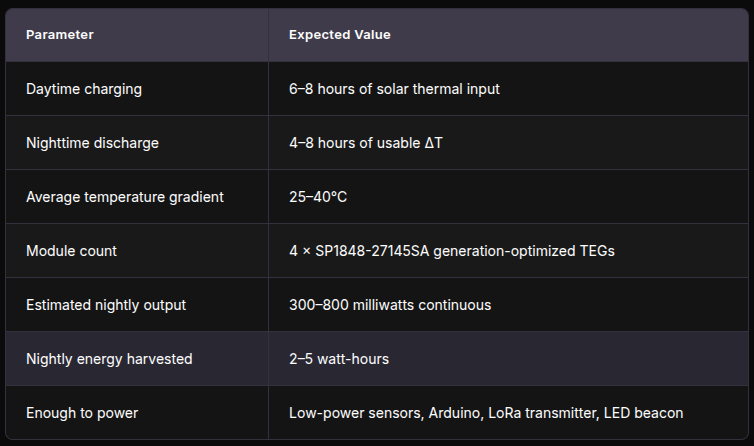
The Numbers
Why This Matters
Most renewable energy conversations focus on large-scale generation — solar farms, wind turbines, grid storage. But there’s an entire tier of energy demand that’s invisible: the millions of small, distributed devices that need milliwatts, not megawatts. Environmental sensors, agricultural monitors, infrastructure beacons, wildlife tracking stations.
These devices currently run on batteries that need replacement, or solar panels that don’t work at night or in shade. A TEG system powered by stored thermal energy could run indefinitely, day and night, with no maintenance and no fuel — especially in a hot climate where temperature swings are extreme and predictable.
What’s Next
I’m sourcing components now and will document the build process, including:
Construction of the insulated thermal storage box
PCM preparation and encapsulation
TEG module mounting and thermal interface optimization
Wiring and power conditioning circuit assembly
Nightly performance logging across seasons
I’ll post measured data — actual voltage, current, power output, and temperature deltas — not theoretical projections. If it works, I’ll scale up. If it doesn’t, I’ll share what I learned and what I’d change.